

Webzine
The Protagonist We Met on the “Yuja Hill”: Song Jae-cheol
2025.12.15
Visiting the Production Sites of Nenia Products (12)
Eden Foods Agricultural Cooperative
There is nothing to waste in a yuja (yuzu)
The peel becomes yuja syrup, the juice sells out as soon as it is available, and the seeds are pressed for oil used in cosmetics.
Yuja has three times more vitamin C than lemons, making it helpful for preventing colds.
Nenia Organic Yuja Aing is made with organic Korean yuja and organic Korean yuja concentrate.
The maker of this product is Eden Foods.
As winter approaches, orders for Yuja Aing have increased sharply.
The Nenia Webzine team visited a yuja orchard in Goheung, Jeollanam-do—where the fruit ripens in November—to hear the story of Eden Foods, a story that moved us to tears.
“Three Years Living in a Tent by the Goheung Sea”
Song Jae-cheol (74), head of Eden Foods, came to Goheung after his construction business failed in Yeosu and he spent time working in fisheries. He lived for three years in a tent pitched along the Goheung coastline. Whenever village women brought small amounts of rice they had saved at the local mill, he often cried. His daughter, then one year old, once tripped over a fishing net and nearly died.
One day, he happened to notice yuja trees growing on land.
He thought: “The sea is unknowable and can betray you, but yuja trees are visible—you can trust them.”
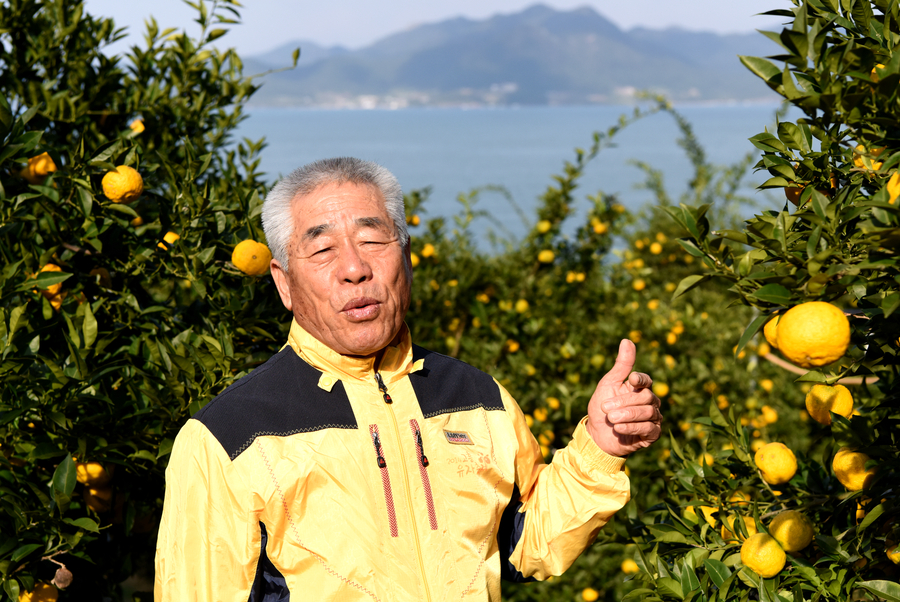
△ Song Jae-cheol shows the yuja hill he cultivates, explaining that the sandy soil drains well and the sea breeze creates ideal conditions. (Photo: Nenia)
Born in Icheon-ri, Hwayang-myeon, Yeosu, Song ran a construction business before turning to fishing—two years in Yeosu and seven in Goheung. Life at sea meant setting out at 2 a.m. and battling rough waves. He grew weary of never knowing the currents beneath him. By contrast, yuja trees—once a prized fruit in regions like Goheung, Yeosu, Wando, and Namhae—seemed reliable. Back in the 1980s, yuja cost 20,000–30,000 won per kilogram; a single tree could send a child to college, earning the nickname “the college tree.”
“So I planted my first yuja trees in 1988. Back then, farmland in Goheung cost 500–700 won per pyeong. Whenever land became available, I bought it. In 1987–88, Seoul investors drove the price up to 1,500 won per pyeong, but I still purchased land. Then I planted yuja, pomegranate, and loquat. Yuja outdoors, pomegranate under rain-shelters as eco-friendly crops. Early on, the business did quite well—our products entered natural-food shops nationwide.”
Song was once appointed to the Goheung Post Office Customer Representative Committee, thanks to his high parcel-shipment volume. His yuja farming and processing business kept growing: yuja tea, yuja purée, yuja cosmetics, and more. Eden Foods employs 6–10 regular staff, and 50 or so workers during the yuja-tea production season (Nov–Dec). As of 2025, sales are around 3 billion won, though he says it has been a difficult year; the goal is 5 billion.
Major Career Milestones of CEO Song Jae-cheol and Eden Foods
1988 — First planted yuja trees
1998 — Received business license for Eden Foods
2005 — Awarded Goheung Yuja Promotional Contribution Prize
2007 — Received pesticide-free certification
2008 — Appointed member of the Goheung Post Office Customer Advisory Committee
2010 — Received Jeollanam-do Eco-Friendly Agriculture Award
2011 — Received Organic Processed Food Certification
2013 — Received Jeonnam Agricultural Management Award
2016 — Received Presidential Award
2019 — Achieved 500,000 dollars in yuja juice exports
2019 — Received World Master Craftsman Award
How Yuja Came to Korea
Historical records say that even during the Joseon Dynasty, yuja from Goheung was so esteemed that Chinese envoys wanted it cultivated for imperial tribute. According to tradition, the sailor-general Jang Bogo brought the fruit from Tang China in 840 CE, spreading it across Korea’s southern coast. The Annals of King Sejong note that in 1426, yuja was planted in Jeolla and Gyeongsang provinces, and yields were reported to the state.
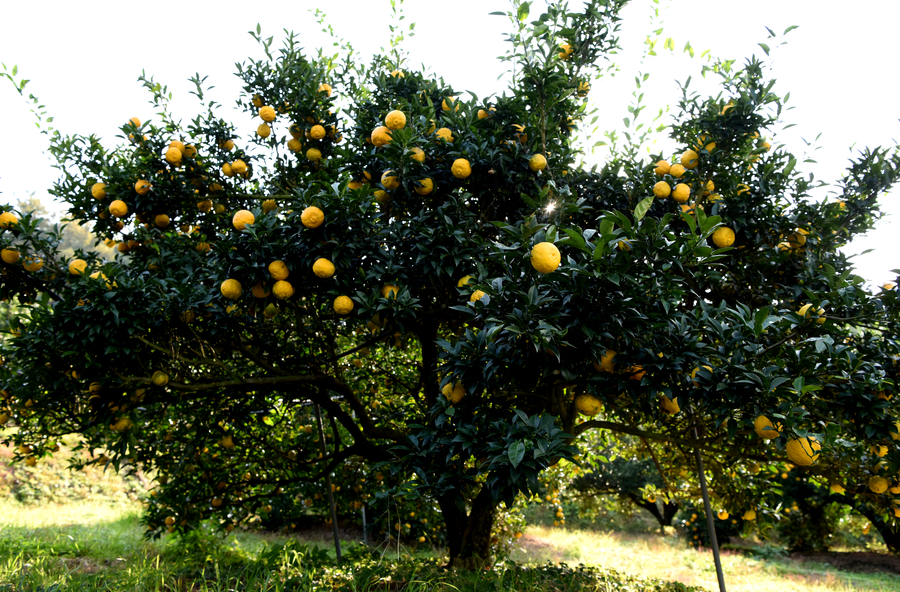
△ Yuja trees in Song’s orchard (Photo: Nenia)
Yuja is extremely sensitive to climate.
Goheung, Wando, Jindo, Namhae, and Geoje—regions along the southern coast—lie at the northern limit of viable yuja cultivation. Goheung alone accounts for over 60% of yuja grown in Korea. Yuja is produced mainly in Korea and Japan; Chinese production is negligible, meaning imports are almost nonexistent.
Choosing Eco-Friendly Cultivation—for Himself
Eden Foods farms about 20,000 pyeong (≈66,000 m²). Whether certified organic or pesticide-free, both require no pesticides and no herbicides. Weeding is the hardest task. In midsummer, it must be done every 10 days, leaving one row of grass so pests do not climb the trees.
Preparing eco-friendly treatments is not easy either. Conventional farmers might spray once a month; eco-friendly growers spray 2–3 times a month, plus additional treatments when it rains. If not, pests become unmanageable. Fungal diseases are controlled with sulfur. Some years, heavy rain in July–August has caused black spot disease across the orchard, making harvest impossible. Proper pruning is also essential for marketability.
Some trees bear heavily while others bear little; this is alternate-year bearing, and rotating which trees rest each year helps maintain stable harvests.
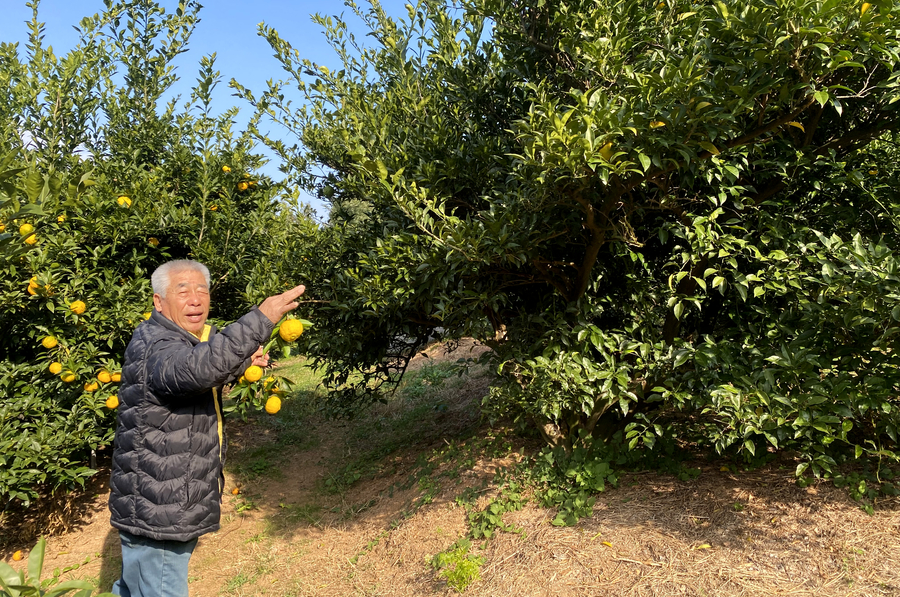
△ Song explains alternate-year bearing in yuja trees. (Photo: Nenia)
Song says he chose eco-friendly cultivation first and foremost to protect his own health: When you spray chemicals, the person spraying gets harmed. If you do not spray, you protect yourself. Over time, he naturally came to consider the land, the trees, and the consumers.
“Seventy Percent of the Trees Died from Frost”
Climate Change Spares No Yuja Tree
But farming is never smooth. Five years ago, a severe cold spell devastated the orchard; about 70% of the 20,000-pyeong orchard had to be replanted.
Yuja trees die when temperatures of –5 to –6°C persist for a week. Cold weather also reduces fruit set. Song says the damage was so great “the cooperative almost disbanded.” Yuja prices have risen accordingly.
Eden Foods was among the third or fourth processors to begin operations out of the roughly 30 processing factories currently in Goheung. They have received many awards, including a Presidential Prize—but how were their products developed?
Universities such as Sunchon National University and Honam University researched technologies and passed them on, but above all, because the producer himself knows the characteristics and depth of yuja better than anyone, Song and his family developed the products directly. Beyond the familiar yuja drinks and yuja tea, Eden Foods has created a variety of items such as yuja juice, yuja purée, yuja salt, and cosmetics.
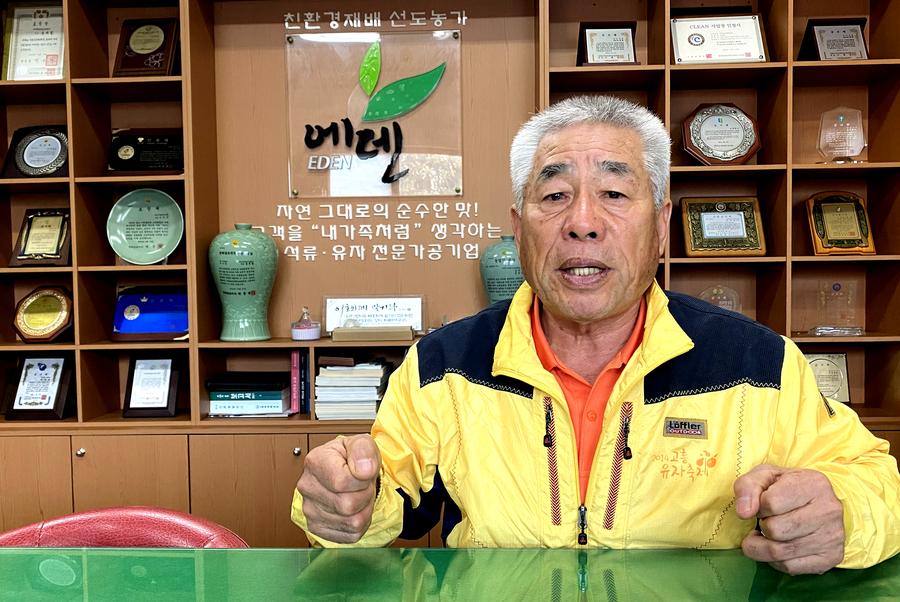
△ Awards for eco-friendly agriculture and yuja production fill the walls of Eden Foods’ office. (Photo: Nenia)
Song’s three children all work in the family business: his son runs the factory; his daughters’ families handle administration, operations, sales, and PR. Where Song lacks, they fill in; where they lack, he fills in. He emphasizes that even in a family enterprise, no one behaves carelessly or selfishly—each person has firm responsibilities, and family meetings are frequent.
Nenia’s “Organic Yuja Aing”
Nenia Organic Yuja Aing contains 12% organic Korean yuja, 6% organic Korean yuja concentrate, 8% organic sugar, and purified water. It carries organic agricultural, organic processed-food, and HACCP certifications. This is the very product made by Eden Foods.
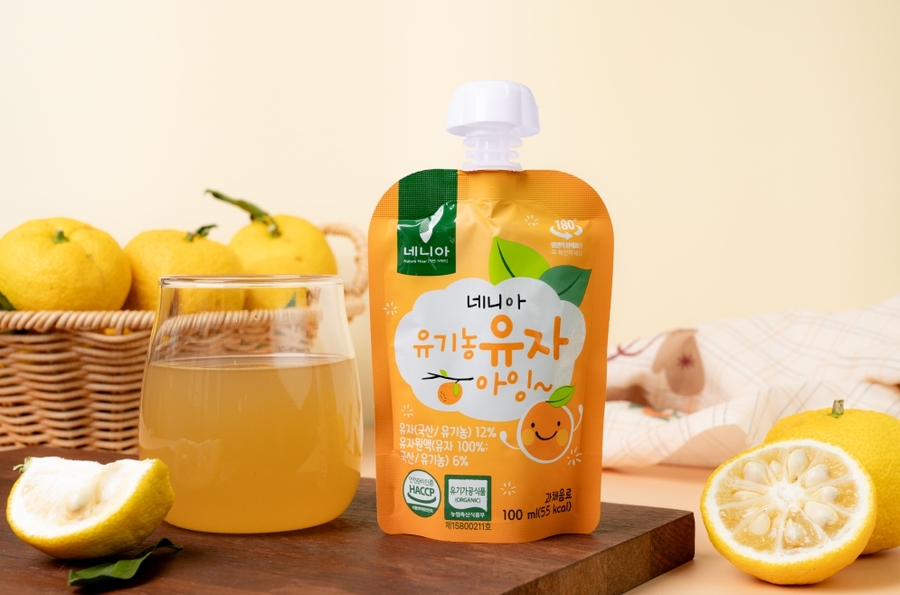
△ Nenia Organic Yuja Aing (Photo: Nenia)
Originally, Eden Foods produced Nenia’s yuja products using its own organically grown yuja. But after the frost disaster killed about 70% of the orchard, obtaining certified organic seedlings became difficult. They replanted with regular seedlings and have since been certified only pesticide-free. For this reason, Eden Foods now works with three to four local organic yuja farms under contract, using their fruit for Nenia products.
Although Eden’s own orchard cannot currently operate as fully organic, the company buys yuja from organic growers lacking processing facilities—providing those farmers a stable market. It is fortunate that the organic yuja growers and Eden Foods have formed a mutually beneficial, cooperative relationship.
“I Want to Walk My Father’s Path”
A Household Living Together, Warmly
When asked about his hopes for the future, Song replied without hesitation:
“I want to walk the path of a father.” During his difficult younger years, he could not hold his children warmly; sometimes they had to be left with their grandparents. Although his children are now independent with families of their own, Song wants to live close to them and give them the warmth he once could not. He spent too many years apart, shedding tears in his car from sorrow. Half of that dream has already come true—his children work together with him, and they all live nearby.
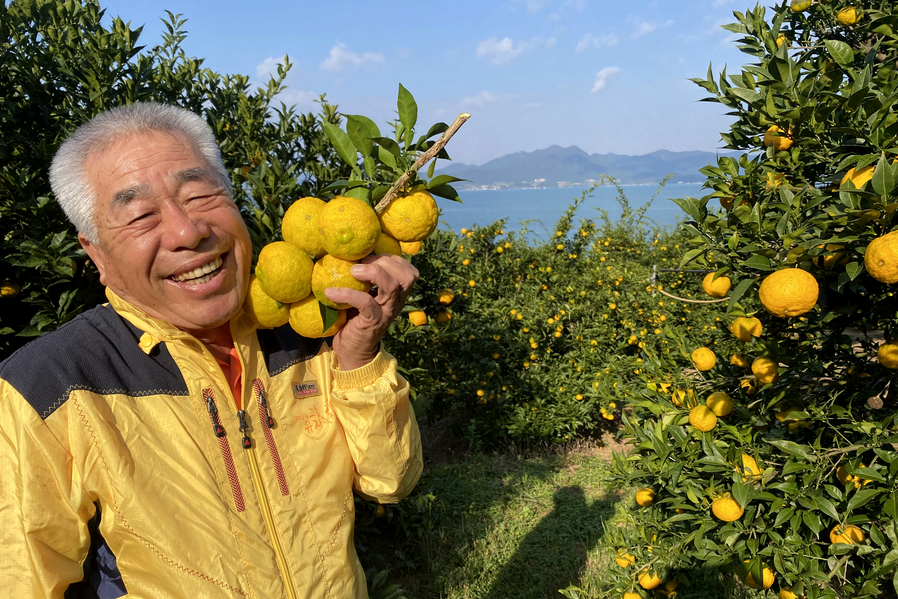
△ After enduring many hardships, Song is now a well-regarded yuja grower and processor in Goheung. His face beams with joy, especially with his family by his side. (Photo: Nenia)
Song’s philosophy: Do not chase money blindly, do not invest recklessly. Manage and invest without debt. Operate efficiently and make products of real substance.
He served as president of the Organic Processed-Food Factory Association for seven years, has been a director of the Yuja Agricultural Cooperative from its early days, and leads or participates in several local organizations. He also serves as the head of the Specialty Crop Research Association, the director of the Goheung Space Choir, and the president of the Jeonnam Traditional Processing Association.
He says, “You could say I’ve buried my bones in yuja farming.”
Eden Foods—run by the whole family—is full of vitality and warmth. Like Eden in scripture, the hill filled with yuja trees is both the fruit of Song’s labor and the reason he lives. If Eden is a sanctuary, then for him, the yuja hill is that sanctuary.
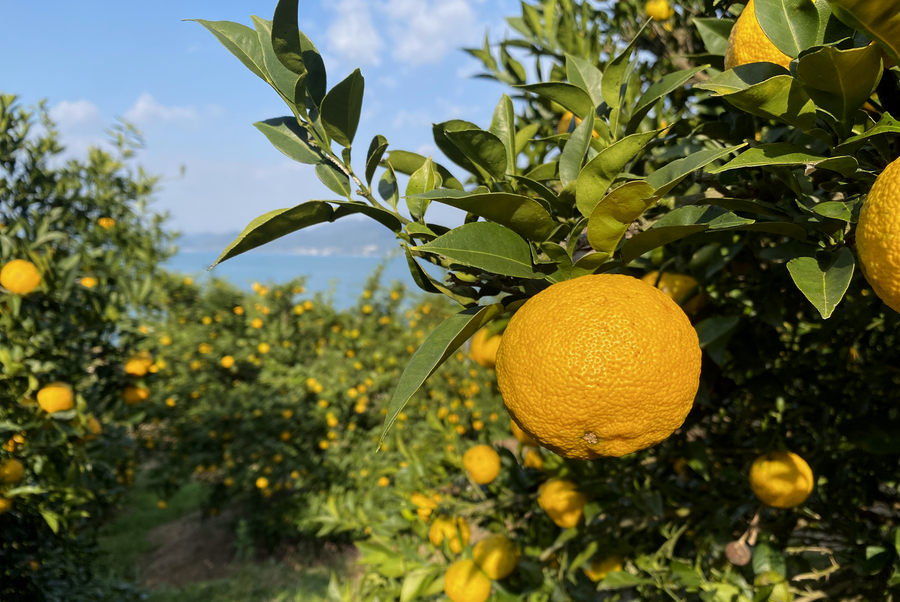
△ On the hill overlooking the sea, yuja glow like lanterns. (Photo: Nenia)
Nenia Web Magazine Editorial Team
November 2025


