

Webzine
[People Looking for Nenia] “Dulbap” for Eating Together and Living Well Together
2026.01.16
[People Looking for Nenia] ③ Han Min-seong, CEO of Dulleoanjeun Bapsang
Ten Minutes to Eat a Meal, Six Months to Make It
-
Nenia products used: Nenia breads and cookies, beverages, Nenia pesticide-free/organic Korean wheat flour, Nenia organic pumpkin sikhye and traditional sikhye, organic ice cream, Nenia dumplings, and many others
“Fruit should ripen on the tree,” “Vegetables should grow in the soil,” “Ten minutes to eat a meal, six months to make it,” “Oppose pair trawling”….
The language used by the online shopping mall he runs was anything but ordinary. A deep respect for agriculture could be felt throughout, in both tone and choice of words, and there were sentences infused with a literary sensibility as well.
He is someone who knows how to take to heart a bus driver’s remark—“The world changes little by little, like this”—and who does not let slip past the story of a farmer asking, “Must we become poorer the more faithfully we keep to the basics?” He carries those voices to consumers. I was very curious to know who the person was behind the writing and design of the shopping mall.

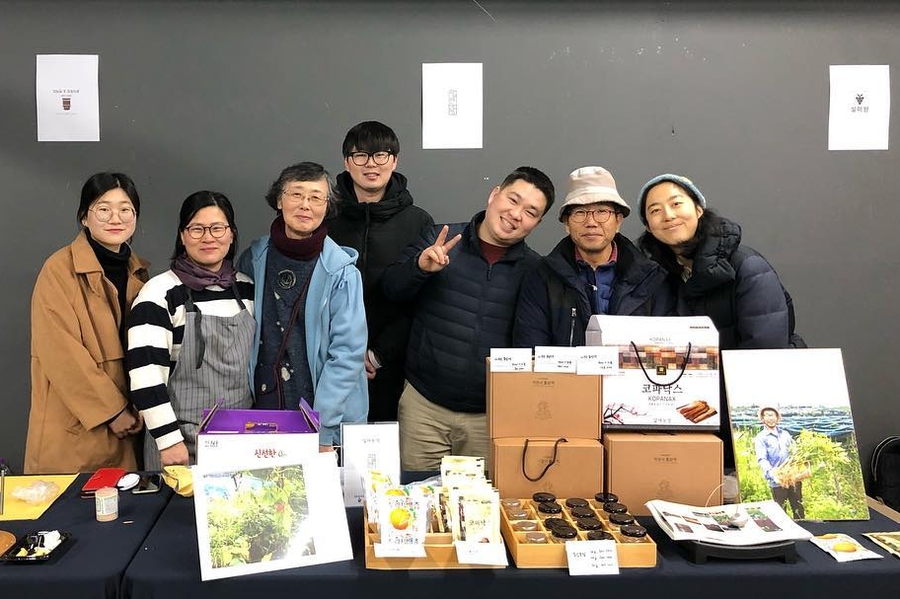
△ Photo courtesy of CEO Han Min-seong
Dulleoanjeun Bapsang (hereafter Dulbap) sells a remarkably wide range of Nenia products, including yuzu muffins, Korean wheat white flour, Kkwakchan Goya meat patties, Korean wheat tteokbokki rice cakes, sandwich pastry sheets, dumplings, bite-sized pork loin cutlets, various rice cakes, strawberry shakes, organic fresh strawberry jam, organic ice cream, udon noodles, ciabatta, cookies, sikhye, mayonnaise, Jin ketchup, and many others.
There are quite a few distributors that handle Nenia products. Among them, Dulbap stands out as one of the places that explains Nenia products particularly well—“in a very Nenia-like way.” Why, then, does the head of Dulbap choose Nenia products? To answer that question, the Nenia webzine traveled to Gongju, South Chungcheong Province, on December 10 to meet Han Min-seong, CEO of Dulbap.
Encountering “Eco-Friendly Agriculture”
CEO Han says that he was not interested in “eco-friendly” practices from the very beginning. Looking back to the time when he founded Dulbap, around 2008 he completed the SGS Social Enterprise Academy run by the Economic Promotion Agency. He thought that he would probably start a business someday, and decided that if he was going to do it, he might as well do it sooner rather than later.
He believed he was strong in online work and had both interest and confidence in food, so he created Dulbap. In the early days, the business began by assembling boxes of representative products from rural villages and delivering them to households. At the time, such produce box subscriptions were not yet common. It was during this period that he happened, by chance, to meet people involved in the “school meals movement.”
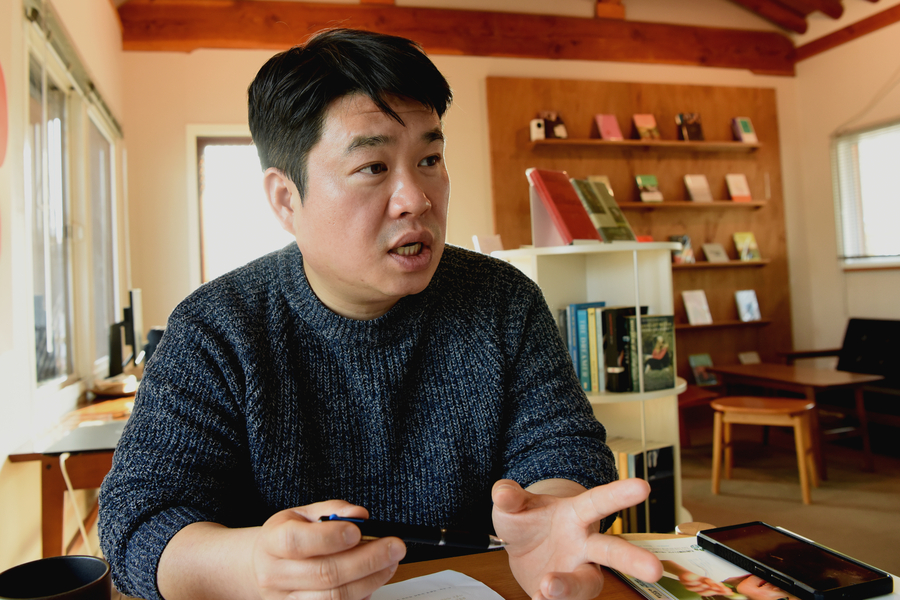
CEO Han said, “I met many people—the living legend of the school meals movement, Lee Bin-pa; CEO Lee Won-young, who works in the distribution of eco-friendly agricultural products and is deeply concerned with guaranteeing farmers’ production costs; people active in farmers’ organizations across the country; people involved in food education and food culture; and Nenia Executive Director Song Jeong-eun, who allowed me to see, in real life, what it means to live with complete alignment between philosophy and action. Through meeting these people, I came to encounter the term ‘eco-friendly.’”
He began thinking about what “must be done right now” and started working together with small-scale eco-friendly farmers. In that process, the very first product Dulbap sold was pesticide-free kabocha squash produced in Oligo Village, Dangjin.
He created “fans” for each farm and worked to expand their reach, adding storytelling and branding in the process of turning products into marketable goods. Ideas and tasks came to him endlessly, and creative thoughts kept flowing. He met countless farmers, sometimes working so closely that he was practically farming alongside them; he ran back and forth to find sales channels for farmers who lacked access to markets; and at times, he even sold and promoted products together with producers at offline stores without pay.
Enduring Hard Times Through Customers’ Letters
According to Han, the process of visiting production sites, turning harvests into products, collaborating with farmers, and selling those products did not lead to making a lot of money. Because he was involved in every stage—from production to sales—there were practical limits on how much he could do in marketing or product development.
What gave him the strength to endure difficult periods was, above all, his customers. When customers sent letters or messages saying thank you for helping them purchase good products, it gave him renewed energy. During one particularly difficult time, he posted on social media that he was struggling to raise the office security deposit. In response, CEO Kim Dong-wook of JKD Partners offered him office space free of charge, and since the year before last has also provided investment support.
Thanks to that support, Han says, he has been able to do the things he had long wanted to do—such as helping a yuzu farm that had been forced to halt processing because it could not afford to reinforce its processing line, and actively promoting products even while paying for advertising. In moments like these, people he feels deeply grateful for have come into his life.
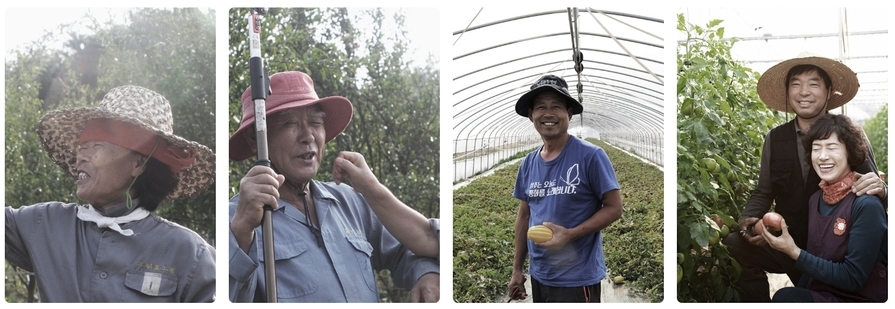
While working, there are moments when he feels taken aback. Among his business partners are farmers who struggle to use KakaoTalk properly, and others who don’t know how to organize shipping invoices in Excel or Google Sheets, so they take photos of each invoice one by one and send them instead. When someone sends around fifty photos like that, each one has to be entered manually and turned into proper records. He often encounters farms that have never signed a courier contract or don’t know how to manage shipping labels.
Small-scale farms have a very limited amount of labor available in a day, and even focusing solely on farming is not enough to get everything done. They still have to squeeze in many other tasks. Those tasks need to be made as easy as possible through support. From choosing seeds and farming, to selling the products and having the income finally reach the farmer’s bank account, CEO Han sits down with farmers, putting their heads together to find ways to make the whole process actually work.
Beginning to Sell Nenia Products
The interview then turned in earnest to questions about Nenia. Why did he start looking for Nenia products? CEO Han said that among Nenia’s offerings, he is particularly fond of “Korean wheat garlic toast, organic ice cream and fresh strawberry jam, organic glutinous barley pancakes and waffles, and Simon castella.” He added that products only sell well if he himself is satisfied with them. Even when distributing a single item, he doesn’t just accept it at face value—he carefully examines the product, including visiting the production site.
“Our Dulbap mainly seeks out agricultural and seafood producers and sells raw ingredients or products they process themselves. We don’t accept processed foods casually or indiscriminately.”
Despite Han’s strict standards for selecting products, Dulbap carries and sells many Nenia products and also distributes them through Ddanzi Market. So why does he like Nenia products in particular?
“Around 2020 or 2021—it was during COVID—Nenia Executive Director Song Jeong-eun said they urgently needed to sell ice cream that had originally been made for school meals. With schools closed and meal programs suspended because of the pandemic, they had no outlet for those products. At the time, we listed Nenia ice cream on Dulbap and Ddanzi Market and sold quite a lot. COVID was the backdrop, and when we explained the difficulties faced by school-meal suppliers, people responded.”
That was how his connection with Nenia began. From there, he gradually expanded the range of Nenia products he handled and has now become something of a “Nenia product enthusiast.” He carefully checks the raw ingredients in Nenia products, and when he asks questions like, “Why did you use this ingredient?” he says Nenia always has clear answers right away.
When he asked why egg yolks were used in Nenia’s organic ice cream, the response was that they were used instead of synthetic additives such as emulsifiers, stabilizers, or thickeners that make ice cream easier to form. Han said that made him trust Nenia even more, realizing that they had been thinking ahead about these issues. When he asked why yam was added to Nenia’s jjuzzu-bar (the Omija ice pop), the answer was the same—it was used as a natural alternative to thickeners.
“I was impressed by Nenia’s ability to plan and execute—finding natural ingredients to replace synthetic additives and actually putting those ideas into practice,” he said.

Nenia products are not limited to ice cream when it comes to avoiding additives. CEO Han personally verified numerous Nenia products one by one—including cookies, bread, dumplings, and beverages—traveling to production sites along the way. Through this process, he came to understand the taste of processed foods made with good ingredients, and his trust in Nenia grew. Han did not hesitate to offer advice to Nenia as well.
“There’s a premium food court in Daejeon. The company name includes the word ‘organic,’ but their products contain a lot of additives. Organic sugar is listed first among the ingredients, and the rest is filled with imported ingredients or additives. They package it to look sophisticated and sell it as a premium eco-friendly product.
I hope consumers can recognize products that are eco-friendly through and through, like Nenia’s. For that to happen, I think it would be good to present clear, easy-to-read explanations right at the top of the product page. First, there should be a clear answer to ‘Why should I buy this?’ and only then should the detailed product description follow. Strawberry jam made with imported organic strawberry purée doesn’t become eco-friendly just because it’s packaged to look upscale. To be truly eco-friendly, it needs to be made like Nenia’s—using fresh organic strawberries, and made at low temperature without boiling. I really hope more people come to know about these rare and valuable products.”
During the interview, Han received frequent phone calls. When he’s not on the phone, he’s often jumping into a truck and heading off to see a producer—this is his everyday routine. He says that before selling pears, he visited the pear farm more than ten times. It’s like that everywhere. To sell myeongnan-jeot (salted pollock roe), he once discarded five full rounds of photographs and reshot everything from scratch. Even when visiting the same farm year after year, he documents the site with photos each time, building an archive of the farm’s history over many years.
On the Dulbap website, he introduces more than twenty producers, including Seondol Farm in Gimcheon, which grows plums; Narae Farm in Yeongdeok, which grows peaches; Dongnae Farm in Seogwipo, which grows tangerines; a husband-and-wife fig-farming couple in Haenam; Cheonghae Farm on Gogumdo Island, which grows kiwifruit; and Salmae Farm in Yesan, which produces organic red ginseng. How could one not grow attached to these farms?Among them, Hyodeok Dairy stands out. They make cheese and yogurt, and because Han visited the farm so often, there were times when he even gave the owner’s children rides to school. One of those children has since grown up and now makes cheese at Hyodeok Dairy. After sharing so many years of joy and hardship together, the relationship with Hyodeok Dairy has become something closer than family.
An “Organic” Shopping Mall Without Organics
CEO Han also spoke about what he calls “organic shopping malls without organic products.” He pointed out cases where sellers claim to sell organic napa cabbage but actually list conventional cabbage, or arrange product names so that organic and conventionally farmed items are placed side by side in a way that makes them difficult to distinguish. In some cases, the company name includes the word “organic,” yet no organic products are sold at all. There are even instances where customers leave reviews saying, “We enjoyed the organic product,” on items that are not organic. Han does not let such problems slide; he makes an effort to correct what is wrong.
When consumers complain—asking why mandarins with dark marks left by scale insects were sent, or raising objections based on misunderstandings about organic farming—the easiest and most convenient response is to simply apologize and issue a refund. But Dulbap chooses instead to communicate with customers, explaining that the fruit is not rotten and that such marks are characteristic of eco-friendly agricultural products. As with the bus driver’s remark quoted at the beginning of this article, Han’s efforts like these may be “changing the world little by little.” When a product is genuinely at fault, however, Dulbap takes full responsibility and provides proper compensation.
“Feeding” Alone Does Not Solve the Problem
The Paradox of a Generation Raised on Eco-Friendly School Meals
“Dulbap believes that farming is a public good that must be protected, regardless of the farming method. In particular, if small-scale eco-friendly farmers lose the strength to endure, not only eco-friendly agriculture but agriculture as a whole will be shaken. Agriculture is the foundation that supports people’s lives. Only when this foundation exists can other industries function smoothly. And I believe that at the very bottom, supporting that pillar with their strength, are small-scale farmers.”
These words come from an article Han wrote in 2018, when Dulbap marked its tenth anniversary. When asked whether there had been any progress in the five years since he wrote that piece, Han replied, “If anything, it’s gone backward.” He expressed particular concern about the consumption patterns of younger generations today.
“The Instagram generation doesn’t seem very interested in organic food. That may be one of the major challenges of the next ten years. The generation that grew up eating eco-friendly school meals is now the Instagram generation—but they skip breakfast, eat out or have chicken breast for lunch, and order delivery for dinner.
For them, it’s not the raw ingredients that matter, but the ‘recipe.’ They’re willing to spend money on things with good values, but just like consuming omakase, they’re not interested in the ingredients themselves. It feels like the values of eco-friendly farming and agriculture aren’t being conveyed to them.
But we can’t simply blame them. That’s why I think it’s not enough to just serve eco-friendly school meals when students are in school. What matters is explaining how that food is made, why those standards were created in the first place, and what it takes for the people who produce it to actually uphold those standards.”
Listening to Han’s words, I found myself pausing for a moment. The adult generation had made enormous efforts to provide eco-friendly school meals, yet had stopped at simply feeding children, failing to properly talk with them about eco-friendly agriculture and related values.
Practicing Directly, and Practicing Through Support
On Dulbap’s online shopping mall, there is a product category called “Cow–Pig–Chicken–Egg,” and it vividly demonstrates the power of language. It evokes a distinctly Korean sensibility all at once: scenes of cows and chickens coexisting, straw and eggs, livestock living alongside humans rather than being raised through mechanized systems, and long-forgotten memories from the past. It turns out that Han majored in Korean literature. He also studied economics and business administration, which perhaps explains the breadth of both his work and his life.
Were his parents farmers? In fact, the head of Dulbap was born and raised in Seoul. He is a person whose actions precede his words. Starting in middle school, he volunteered at places like the Cheongnyangni Franciscan Center, the Bap-ppeo free meal service, post offices, and events at COEX. In his early twenties, he volunteered at an adoption center affiliated with the Catholic Welfare Association, and participated in an after-school program for children living in jjokbangchon—tiny single-room housing areas—in Guro.
At the time, around 2001, these slum neighborhoods coexisted alongside apartment complexes, with 20 to 30 households sharing a single communal bathroom—conditions that make it easy to imagine how harsh daily life was. Han created a sponsorship group to help children who couldn’t afford the 55,000 won fee required to attend the after-school program. The children in the shantytown lacked not only access to after-school classes, but also the money to go on educational outings. So he organized a monthly picnic for the after-school students and formed a support group called “People Who Make Picnics,” through which he gathered donations to make those outings possible.
CEO Han said, “We need people who raise their voices, people who go to the field, and people who remember and do not forget—everyone is necessary.” He said that he is neither an “activist” nor someone who supports a particular political party, but that he does not turn away from places where he is needed.
When farmer Baek Nam-gi passed away in 2016 after being hit by a police water cannon, and citizens at the time kept vigil in tents demanding a full investigation, Han supported the protest site by donating cup noodles and helping to create a fund for food supplies. He sent fruit to medical staff working on the front lines during the COVID outbreak in Daegu, sent donated goods to Gangjeong Village, and provided supplies to solidarity food trucks serving people on the ground.
“Will the World Really Change If I Move?”
When asked to boast a little about Nenia products, he said, “I visited the manufacturer that makes Nenia’s Simon castella. The aroma—from antibiotic-free free-range eggs and pesticide-free Korean wheat—was incredible. I went there to inspect the facility and ended up burying my nose in the castella. If the eggs aren’t good, there’s a fishy smell. But Nenia’s castella is moving. It’s not fragrance—it’s the smell that comes from the raw ingredients themselves. There may be only five flavors, but there are tens of thousands of aromas, and that’s how the Simon castella felt to me.” He praised it without reserve.
Even though Han loves this work, that doesn’t mean it is free of conflict. Traveling all over the country, living with a phone constantly in hand, even delivering agricultural products himself—if he said it wasn’t exhausting, it would be a lie. Sometimes he wants a life where he can go to a labor site without miscellaneous worries and fill the day simply with sweat, or even live like a “naturalist,” removed from it all. I asked him whether there were moments when the work felt especially difficult.
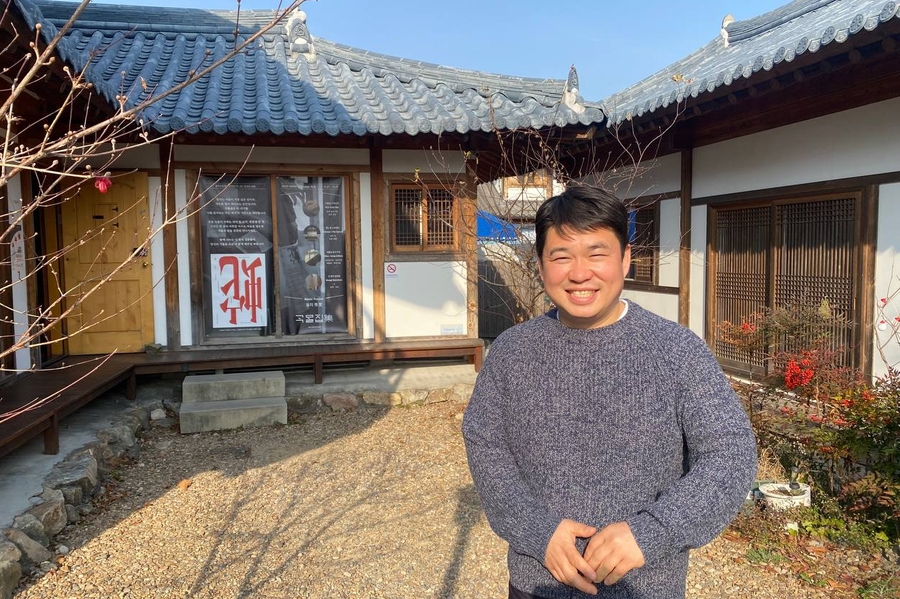
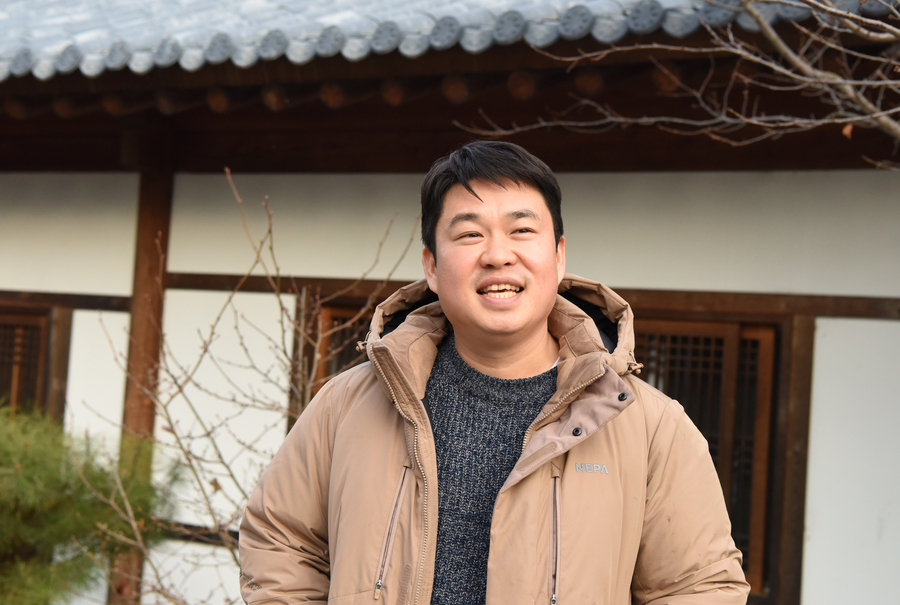
△ Photo taken in the courtyard of “Gokmuljip” in Gongju, South Chungcheong Province, where the interview took place. Han Min-seong comes across as a “man of letters,” a business owner who thinks deeply about agriculture and food, and someone who wants to help create a better world. We cheer on Han Min-seong through moments of fatigue and hardship. (Photo = Nenia)
“I’ve been carrying this question with me for over a decade: ‘Does the world really change just because I do this—and should I keep going?’ Then I think again. A ‘resolution’ isn’t something you reach after a certain narrative arc where your life or attitude suddenly changes. It’s something you make again every morning, and again in every moment. In a way, maybe I’m still doing this because I’m stubborn. And at the same time, I think I endure because of the quiet strength I’ve encountered in the lives of the people I’ve met under the name of agriculture.”
What gives him the strength to endure are the people who recognize his sincerity, those who don’t forget him and come looking for him, and the consumers and producers who remember him and reach out to ask how he’s doing. It is because such people exist.
Like a family that sets the table together and gathers around it, we hope—and cheer—for peaceful, happy days ahead for Han, the small-scale eco-friendly farmers he works with, and Nenia as well.
* Dulleoanjeun Bapsang shopping mall: https://doolbob.co.kr/
December 2025
Nenia Webzine Editorial Team


